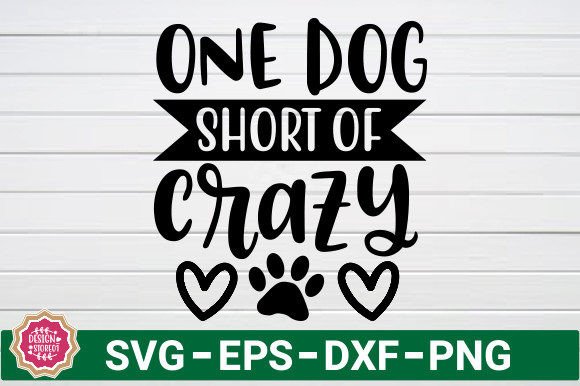
One Dog Short of Crazy SVG
Let’s be real: I opened One Dog Short of Crazy SVG not to admire vector curves, but to ask one question — “Will this stitch cleanly, sell well, and make my client smile?” As a designer who’s digitized over 300 embroidery files and shipped custom embroidered totes, baby onesies, and boutique aprons for eight years, I test every graphic like it’s going straight into production — no do-overs, no “good enough.” So when a craft business owner asked me to evaluate One Dog Short of Crazy SVG for their holiday gift line, I treated it like a real brief: no fluff, just function, feel, and finish.
A Design That Winks Before It Stitches
The first thing that hits you isn’t the dog — it’s the tone. Playful, warm, slightly irreverent, but never chaotic. The layout is balanced: compact enough for a 4” hoop, yet full of personality in its hand-drawn lettering and expressive canine silhouette. There’s no excessive ornamentation — no swirls, no shadow layers, no unnecessary flourishes. That’s good news. In embroidery, simplicity often translates to fewer thread breaks, cleaner satin stitches, and better readability at small scales. This isn’t an applique design demanding precise fabric placement or raw-edge finishing. It’s a clean, single-layer machine embroidery design built for clarity — especially on cotton tees, canvas totes, and brushed poly sweatshirts.
Where It Shines (and Where It Needs Guardrails)
I ran One Dog Short of Crazy SVG through three real project scenarios: a linen tea towel for a pet-themed kitchen shop, a baby onesie for a boutique’s newborn collection, and a twill cap for a local dog-walking startup. Here’s what held up — and where I paused.
- Tote bags & tea towels: Perfect. The moderate stroke weight holds up beautifully on medium-weight woven fabrics. No fill-stitch flooding, no thin lines disappearing under dense stitching. Works equally well with tonal thread (heather grey on oat linen) or high-contrast combos (navy on cream).
- Baby items & onesies: Safe — but only with proper stabilizer. The script letters are legible at 3.5”, but I’d avoid going smaller than 3”. On 100% cotton interlock, I used tear-away + light cutaway and got crisp results. No puckering. No skipped stitches.
- Caps & curved surfaces: Proceed with caution. The bottom curve of the dog’s head and the tail taper get tight on low-profile hoops. I’d recommend testing on scrap twill first — and consider simplifying the tail outline if stitching on structured caps.
Fabric & Finish: What You Can’t Ignore
This design leans into charm, not complexity — which means it forgives minor inconsistencies but won’t hide poor prep. On textured fabrics like terry cloth or bouclé, the lettering stays readable, but fine details (like the subtle ear contour) soften. On dark fabric? The PNG’s transparent background makes mockup prep easy, but remember: white or light thread will need underlay and possibly topping spray for coverage. On stretchy knits? Yes — but only with a lightweight cutaway stabilizer and reduced top tension. Skip the jersey without stabilization; those curves will distort.
And about washing: because One Dog Short of Crazy SVG avoids ultra-thin lines and dense fill areas, it holds up well across repeated laundering — critical for baby embroidery, kitchen towels, and personalized gifts meant to last.
Commercial Use: Trust, Clarity, and Quiet Confidence
For Etsy sellers and small shop owners, this isn’t just a digital embroidery file — it’s a brand signal. Customers scrolling past hundreds of listings notice consistency before color. One Dog Short of Crazy SVG reads as handmade, intentional, and human — not AI-generated or mass-produced. That builds trust. When stitched on a canvas apron for a dog bakery, it felt cohesive, not cutesy. On a holiday pillow cover? Warm, giftable, unforced. That kind of resonance matters more than perfect kerning.
It also plays well with branding. Because it’s delivered as an original vector file (SVG, EPS, DXF), you can adjust proportions non-destructively — scale for a patch, reposition for a left-chest sweatshirt layout, or tweak spacing for a narrow tea towel hem. And yes — colors can be changed very easily. Swap the dog’s collar from red to mint in seconds. That flexibility is gold for craft businesses juggling seasonal palettes or custom orders.
Practical Designer Notes — Not Suggestions, Just Checks
Before you load One Dog Short of Crazy SVG into your machine or list it on Etsy:
- Test on scrap fabric — same type, same stabilizer, same thread count you’ll use in production.
- Check stitch density visually. Look for overlapping satin stitches or overly tight corners that could snag.
- Confirm hoop size compatibility. If your smallest hoop is 3.5”, avoid shrinking below 3.25”.
- Inspect small details in black-and-white mockups. Does the dog’s eye read clearly? Does the “crazy” tail loop stay distinct?
- Compare contrast on both light and dark fabric previews — especially if selling digital embroidery files or printable mockups.
- Verify licensing terms. This is a Graphics product, not pre-digitized embroidery — so confirm whether the license covers commercial embroidery of finished products or resale of the digital file itself.
Final Thought: A Reliable Spark, Not a Flashy Gimmick
One Dog Short of Crazy SVG won’t win awards for technical innovation — and it shouldn’t. Its strength is in reliability, warmth, and quiet versatility. It fits naturally into Crafts workflows: as a tote bag design for a local farmer’s market stall, a personalized gift for a rescue volunteer, or a consistent logo element across a pet-care brand’s merchandise. It doesn’t shout. It connects. And in handmade product markets, that kind of grounded, stitch-ready charm is rarer — and more valuable — than you’d think.